

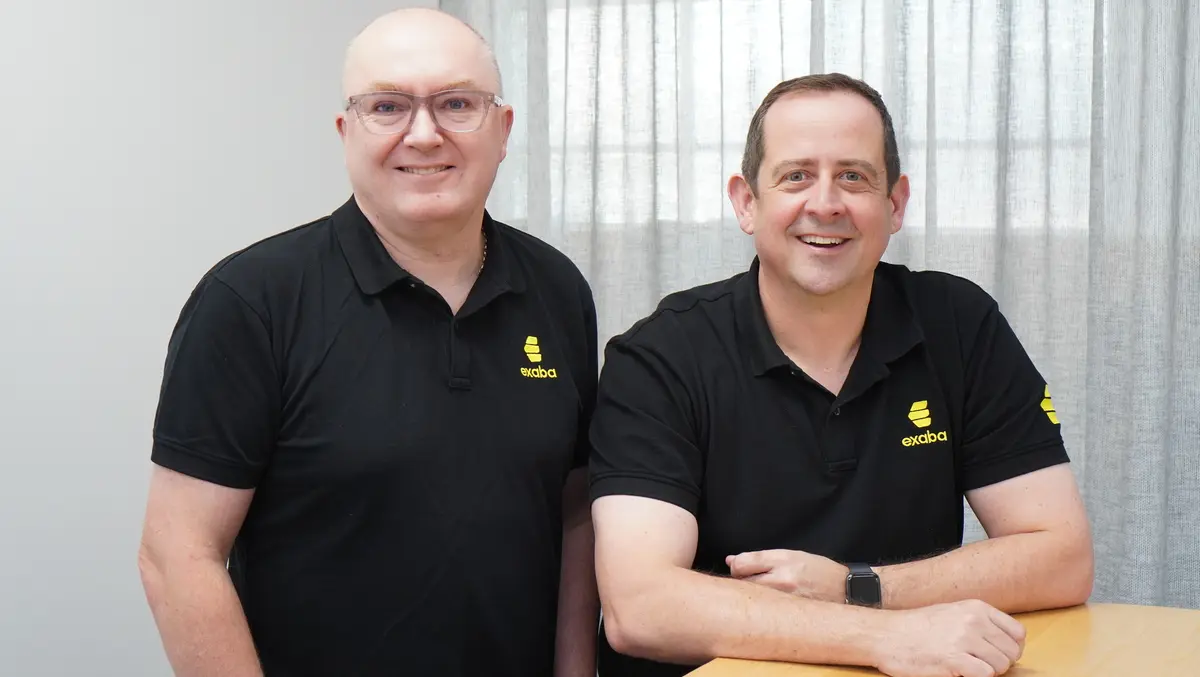
Data storage gets profitable as Exaba targets US expansion
Mon, 22nd Jun 2026
Hot on the heels of a successful seed funding round, data storage software provider Exaba is executing plans to take on one of the most hotly-contested and lucrative markets on earth: the United States of America. The traction Exaba has gained in the local and Australian managed services provider markets, where its value proposition of substantial margins on one of the most in-demand resources has quickly earned loyalty, is expected to resonate with at least a fair proportion of the some-55,000 MSPs conducting business in the American heartland.
Waikato-founded Exaba is taking on the world's dominant cloud storage providers, including AWS and Microsoft Azure, with the premise that hyperscalers cost too much, particularly for managed services providers (MSP) trying to earn a crust on a 'race to the bottom' commodity. In fact, Exaba claims its LocalScaler platform underpins delivery of enterprise-grade, locally managed storage with an 80% margin while still being priced at just one twentieth of similar hyperscaler services.
Co-founder Dr. Stuart Inglis explains: "We are building a cloud for the individual MSP, something that's been traditionally hard to do without a large Linux and Windows technical team. We take out the complexity if you'd like your own cloud tomorrow instead of AWS or Azure. Our long-term aim is to deliver a storage solution for the MSPs who are telling us that online storage is getting too expensive for their end users. Something like 60 to 70% just can't afford cloud any more, and even regret going online at all."
So, Exaba storage (hosted on commodity hardware typically in a local independent data centre) is both simple and profitable for the MSP, and affordable for their customers.
Notably, the considerable smarts behind Exaba meant they went straight to their prospective customers before assuming a LocalScaler storage cloud would be in demand. Inglis said the team went to MSPs and asked them (if that seems obvious rather than revolutionary, bear in mind that many software developers simply don't engage with the users for whom they build products).
Fellow co-founder and Exaba CEO Peter Boyle said: "It was important that we didn't go and build something by ourselves and then ask MSPs if they wanted it. We sat with them for two years, understood exactly where the pain was, and built to that specification."
Those 55,000 MSPs in the states represent quite a carrot. With Exaba's value proposition validated by strong demand locally, along with the seed round pulling in some $12-million in capital, the stage is well set.
Of course, the USA market is always a tough nut to crack. There's no shortage of competitors. Most MSP in this market has existing storage service providers, long-term relationships, and Marketing Development Funds and other incentives on tap from the hyperscalers.
What they don't have is Annual Recurring Revenue from storage, or if they do, it's peanuts. That's where Exaba rolls out what it believes to be an irresistible value proposition. Its figures show that on a typical $20 million MSP, where storage generates $5 million in revenue at 10% margin, switching to the Exaba model could represent a margin improvement of more than $3 million for the business.
In the squeezed MSP market, margins matter.
But winning those MSPs depends on more than sound technology and the promise of margins. Exaba is backed by the international experience of Inglis and the attention of early investor Guy Haddleton, positioning it well for success. After all, Haddleton has walked the talk of international expansion with his companies Adaytum (which rolled into IBM Cognos in the early 2000s) and Anaplan, and as part of the Xero success story (Inglis himself was an early Xero investor).
In a statement, Haddleton said, "I've had a front‑row seat to companies scaling, and once you've run the hyper‑growth engine yourself, you recognise the moment a market has to reinvent itself. That's where we are now. Data is exploding, and…Exaba sits alongside the most exciting startups I've seen take flight in recent years."
More than that, the company is doing what any Kiwi organisation with star spangled banners in its eyes should: Putting qualified boots on the ground, in this case in the form of dynamic Chief Customer Officer and now President of the USA, AJ Tills. "Just for Exaba, of course," Tills laughed.
Tills is known for his work launching Uber into Australia and New Zealand, and in addition to this crucial 'large American vendor' experience, he's worked on the ground in the USA and elsewhere internationally. This value cannot be underestimated; Americans do business distinctly differently from how we operate in New Zealand. Tills is relocating to Austin, Texas, from where he'll run the Exaba North American operations.
He's done his homework, including attending a recent MSP conference in Las Vegas. "We've got two development partners already, and again, critical for our journey to date is listening to MSPs and OEM providers and understanding exactly what they want us to build. As we go into the US, we'll deepen our relationships in that community, which got off to a start at the [Vegas] MSP summit. We're getting our message out there and it is getting the attention we want."
That's because while the way Americans do business does differ, what really matters for the MSP is universal: decent margins while meeting customer needs.
Sticking to the by-now common adage that no story is complete without mention of AI, Tills made an interesting margin-related observation. "Research we did showed that 41% of MSPs say implementing agentic AI at their customers is going to be the largest source of their revenue this year. But another 37% said that AI is the biggest threat to their margins. Put those two together and what you have is a business model at risk…"
Which means making money on foundational commodities is even more tantalising, said Tills. "For the last 20 years really the solution has been to just hand data over to Azure or AWS. It was easy and scalable, but over time with hidden fees and unpredictable costs, it turned out not to be fit for purpose. Many MSPs have responded by coming back on-prem. What we've done is create a solution at an incredibly affordable cost so that MSPs can for the first time ever build a high margin storage business."