

Exclusive: ABBYY launches hybrid AI document models
Tue, 15th Sep 2026 (Yesterday)
ABBYY has launched Phoenix Plus, a set of generative AI models designed to work alongside its established document-processing technology, as enterprises confront the reliability, governance and cost challenges of putting AI into production.
Hybrid launchInitially available through an application programming interface, Phoenix Plus forms the generative component of ABBYY's broader Phoenix portfolio. ABBYY plans to integrate the models more deeply into its Vantage document AI platform, giving customers greater control and guidance when deploying generative AI.
The release reflects ABBYY's view that large language models should complement, rather than replace, deterministic technologies in business-critical document workflows. Its existing models handle image enhancement, layout analysis, parsing, optical character recognition and intelligent character recognition.
Phoenix Plus adds generative capabilities for tasks requiring greater flexibility or more advanced document understanding. The models have been selected, customised and fine-tuned for document processing using proprietary datasets, model research and experience gained from processing billions of documents.
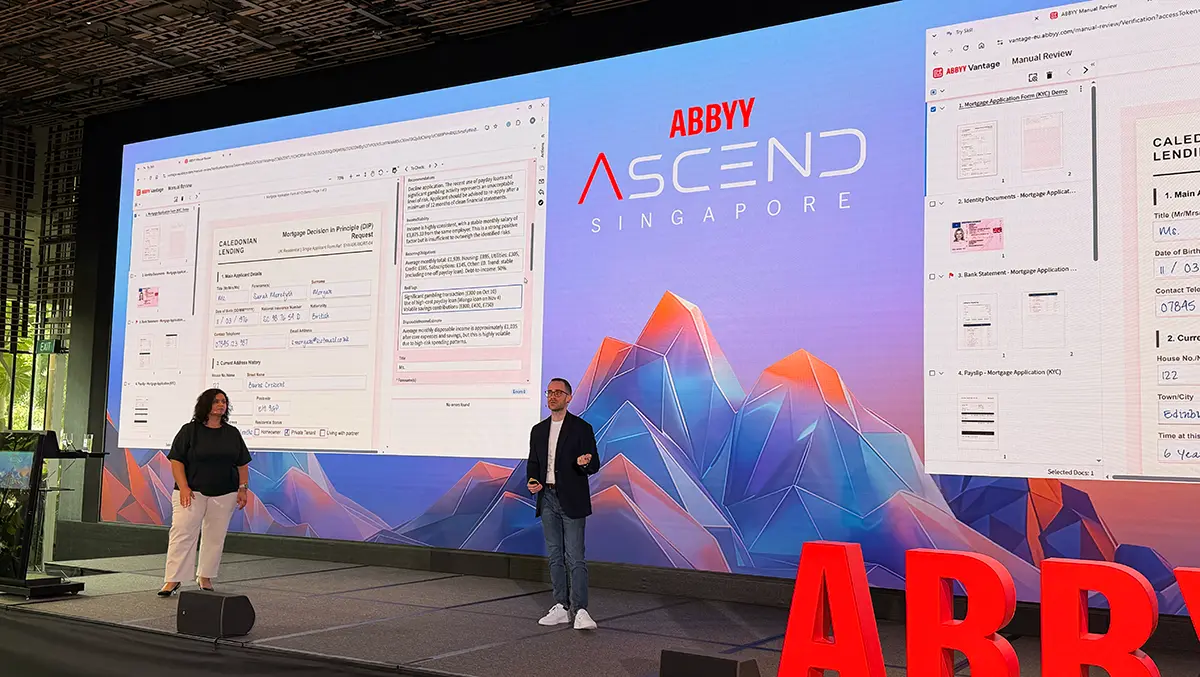
"Phoenix is not just one model. It's really a portfolio of both deterministic and generative models that are integrated and optimised for document processing by us at ABBYY," said Slavena Hristova, Director of Product Marketing, ABBYY.
ABBYY is also exploring smaller, domain-specific language models for particular industries and use cases. These models are intended to increase precision while reducing computational requirements and operating costs.
Phoenix Plus does not require customers to standardise on a single AI architecture. ABBYY's document-processing pipeline can apply rule-based extraction, machine learning, large language models or visual language models at different stages, depending on the document and task.
"It allows you to plug, at each one of these steps, the technology that actually makes sense for this part of the process, or that actually makes sense for this use case and for this document type," added Hristova.
A structured invoice, for example, may require only OCR and rules-based extraction. Contracts and other highly unstructured documents may benefit more from generative models that can interpret variable language and layouts. Customers can also connect models they have already selected or fine-tuned.
Production gapGenerative AI can appear effective when tested on a small number of documents, but processing thousands or millions of files introduces further requirements. Operational documents vary in quality, structure and complexity, while damaged scans, unusual layouts and incomplete information create exceptions that models must handle safely.
Production systems therefore need more than model inference. They may require image preprocessing, document classification, validation rules, exception handling, workflow integration and human review. Organisations must also monitor performance and maintain service levels as models and source documents change.
ABBYY cited a global fund administration company that processes around one million financial documents with complex tables each year. Its internal AI team spent months trying to automate the work but failed to achieve the reliability the business required. The organisation subsequently deployed ABBYY's technology and was operating it within about a month, according to Hristova.
The case reflects the build-versus-buy decision facing enterprise AI teams. Developing an internal system gives an organisation control over its technology, but also makes it responsible for the surrounding infrastructure, integrations, validation mechanisms and long-term maintenance.
Generative models present a particular challenge because their outputs are probabilistic. Processing the same document more than once may not always produce an identical result. A model can also generate information that does not appear in the source, creating operational risk when extracted data informs decisions in insurance, banking, finance or other regulated sectors.
These risks become more serious when automated workflows affect customers directly. Organisations may need to show where extracted information originated, reproduce processing results and maintain audit trails covering automated decisions and human intervention.
Model choiceABBYY already offers a bring-your-own-model option through a prompt-based activity in its Document AI platform. It provides pre-engineered prompts, tools for testing them against customers' documents and controls for managing the output.
The platform supports connections to external generative AI services, including models from OpenAI, Google and Mistral. Microsoft Foundry provides access to a wider selection of models, and ABBYY intends to expand the number of supported connections.
Mistral has attracted interest from European organisations concerned about data sovereignty, Hristova said. Phoenix Plus, by comparison, is hosted by ABBYY and follows the same data privacy arrangements as the Vantage cloud service.
Rather than sending an unprocessed PDF for a model to interpret independently, the platform can provide OCR-derived structure. ABBYY also plans to make its DocLang format available in Vantage. DocLang is designed to preserve more of a document's structure and context, reducing the work required from a generative model and helping to constrain its output.
The orchestration layer routes each stage of a workflow to the most appropriate technology. Customers can use ABBYY's generative models, connect an external model or retain deterministic processing where it provides sufficient accuracy.
Generative AI can also reduce initial configuration time. Traditional machine-learning deployments may require customers to collect and label large sets of sample documents before training models. Generative systems can begin extracting information from fewer examples, potentially shortening the time needed to add a new document type to an automated workflow.
ABBYY's hybrid approach retains that flexibility while using deterministic tools for tasks where repeatability and precise extraction matter more. Generative models can then handle exceptions, unstructured content or stages that previously required human interpretation.
Cost controlsThe economics of enterprise AI are becoming a larger part of deployment decisions as organisations limit token consumption and employees' use of AI services. A model that is economical during a proof of concept may become expensive at high document volumes, particularly if it must repeatedly interpret entire files.
CPU-optimised deterministic models can cost less for routine functions such as OCR, classification and rules-based extraction. Restricting generative AI to stages where it adds measurable capability can also make processing costs more predictable.
"The fact is that this approach of throwing AI and an LLM at every problem is not going to be tolerated for a really long time from now on by finance departments, because there is uncontrolled, unpredictable cost, and very often there is no need to use AI for something that can be solved with much more efficient, much more reliable, much more accurate technology, and something that is simply cheaper to run and operate," said Hristova.
The cost of an internally developed document AI system extends beyond model inference. Organisations must account for infrastructure, validation, monitoring, integrations, exception management and model drift. They also assume responsibility for service-level agreements and the engineering resources needed to maintain the system.
For ABBYY, the production case depends on selecting technology for each task rather than applying one model across an entire workflow.
"You end up optimising the process for reliability, for accuracy, for speed instead of trying to fit the use case to the technology," added Hristova.