

NVIDIA expands US AI manufacturing with partner network
Thu, 2nd Jul 2026
NVIDIA says it is expanding US-based AI manufacturing and infrastructure through a network of partners spanning semiconductor production, system assembly, optical networking, power and data centre operations, as it pushes to localise more of the supply chain behind its AI platforms.
The company said its US partner network now stretches across 43 states and includes work on semiconductor fabrication, packaging, server and rack assembly, optical connectivity and AI factory infrastructure. NVIDIA said the effort is aimed at increasing domestic production capacity for the hardware and systems needed to support AI workloads across healthcare, science, industrial operations and cloud computing.
NVIDIA said it plans to produce up to USD $500 billion of AI infrastructure in the US with partners including TSMC, Foxconn, Wistron, Corning, Lumentum, Coherent and Amkor. It added that, in 2026 alone, NVIDIA-driven AI demand is expected to contribute USD $485 billion to US GDP and support more than 100,000 jobs tied to AI infrastructure.
Supply chain
NVIDIA founder and chief executive Jensen Huang said the company sees the current AI buildout as a broader industrial shift rather than only a technology cycle.
"AI is driving a once-in-a-generation opportunity to reinvigorate American manufacturing and supply chains," said Jensen Huang, Founder and CEO, NVIDIA.
The company said it has already moved advanced semiconductor manufacturing for NVIDIA Blackwell chips into Arizona, with production underway at TSMC's Phoenix facility. It also outlined plans for AI supercomputer manufacturing plants with Foxconn in Houston and Wistron in Dallas, as part of a wider effort to bring more of the AI hardware supply chain into the US.
NVIDIA said this domestic buildout covers three layers of physical AI infrastructure: semiconductor fabrication plants for AI logic and memory chips, electronics manufacturing facilities for boards, servers and systems, and AI factories that convert raw data into AI training and inference output. The company argued that each layer is needed to support the scale of AI deployment now under way.
Public First estimates cited by NVIDIA suggest the infrastructure push is already feeding into a broad employment base, including electricians, plumbers, HVAC technicians, pipefitters, construction workers and other roles tied to plant construction and supply chains.
Factory plans
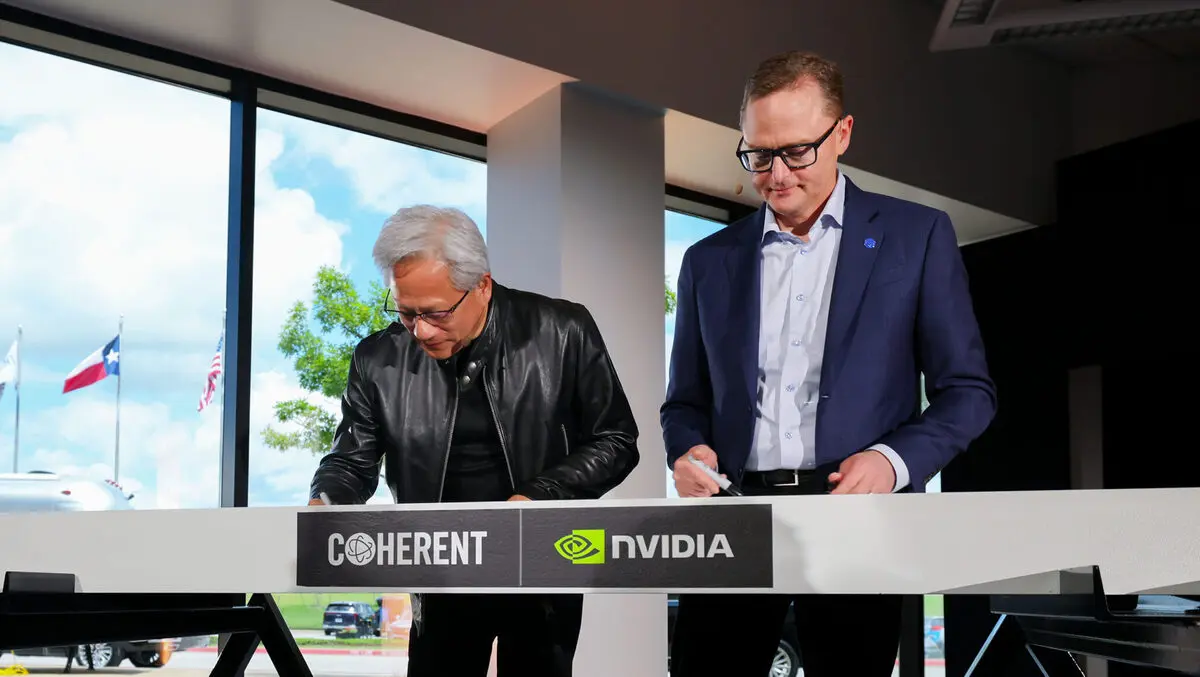
Several partner projects are already under way. In Sherman, Texas, networking supplier Coherent has broken ground on an expanded facility that NVIDIA said will scale production of indium phosphide components used in AI networking systems. The project is expected to create 1,000 jobs.
In North Carolina and Texas, Corning is expanding US manufacturing for optical connectivity products used in AI infrastructure. NVIDIA said that expansion is expected to open more than 3,000 jobs. Lumentum is also increasing US-based manufacturing and deepening optics research and development work with NVIDIA in North Carolina.
Foxconn is building a manufacturing facility in Houston for NVIDIA AI systems, including NVIDIA GB300 tray modules. NVIDIA said Foxconn engineers are using digital twins built on NVIDIA libraries and open models to design and validate the factory's structure, robotics systems and workflows.
Wistron and NVIDIA will also assemble and test NVIDIA AI systems at a new advanced manufacturing facility in Fort Worth, Texas. NVIDIA said the plant was first designed as a digital twin built on NVIDIA AI and Omniverse libraries, with the aim of accelerating production planning and system optimisation.
In Manassas, Virginia, NVIDIA and Digital Realty have developed what the company described as an AI factory blueprint built with US suppliers across the full technology stack, which it says can be replicated elsewhere in the industry.
Jobs focus
Huang said the manufacturing shift is likely to intensify over the next decade as more AI infrastructure is built in the US.
"The onshoring of manufacturing is intensifying," said Huang at the groundbreaking event, highlighting the hundreds of thousands of jobs being created in America. "And most of those jobs are in manufacturing plants. They are electricians and construction workers and designers and technicians. And I think that that's going to intensify over the next decade, because we are seeing the renaissance of manufacturing here in the United States."
NVIDIA said the wider buildout also depends on construction and energy infrastructure providers. It named Caterpillar, Vertiv, Schneider Electric, Eaton, Jacobs, Siemens, Trane Technologies and GE Vernova among the companies helping design, power, cool and operate AI infrastructure in the US. Caterpillar is also using NVIDIA technologies in machines, power systems and factory operations, according to the company.
AI uses
NVIDIA tied the infrastructure investment to downstream AI use cases in healthcare, science and software. In healthcare, it said Abridge is using NVIDIA Nemotron open models and the NVIDIA Blackwell platform for a foundation model built for clinical conversations. NVIDIA said Abridge is deployed across more than 300 US health systems and processes more than 2.5 million clinical conversations each week.
Aidoc's aiOS platform is also cited as a major healthcare deployment, with NVIDIA saying it is used across more than 100 US health systems and 1,300 US hospitals. The company said Aidoc has analysed more than 130 million patient cases to date, including more than 50 million patient scans in the US.
In science, NVIDIA said it is working with Oracle and the US Department of Energy on new supercomputing systems at Argonne National Laboratory. It also pointed to its Earth-2 open models, which it said are being used to improve weather and climate forecasting, including more localised storm predictions.
NVIDIA also referenced broader labour market trends linked to AI adoption. It said about three-quarters of frontline workers are now regular AI users, with 42% reporting that AI saves them a full workday each week. It also cited research from Ramp showing that companies making larger AI investments have seen faster employment growth, including growth in entry-level hiring.
Energy build
The company said the AI buildout is also being shaped by energy, cooling and water constraints, with NVIDIA and its partners working on data centre designs intended to reduce resource use and respond more flexibly to grid conditions. It said the Rubin generation of NVIDIA AI infrastructure is the first to use 100% liquid cooling.
"The NVIDIA DSX reference design for AI factories has zero water consumption - we have eliminated massive amounts of power usage and pretty much all the water usage," said Ali Heydari, Director of Data Center Cooling and Infrastructure, NVIDIA.
NVIDIA said it is also working with Emerald AI and energy companies on flexible data centres that can adjust power consumption in response to grid conditions, as part of a wider effort to align AI infrastructure growth with local power availability and long-term energy planning.
"Ten years from now, I think we'll look back and realize AI is what made it possible to invest in sustainable energy, upgrade our energy grid and reconstitute a workforce," said Huang. "You can't have only information workers in an economy - you also have to have builders. We have an opportunity over the next 10 years to reshape our communities and be much more balanced."